ADHD Time Blindness
Why You Can't Feel Time — And the Tools That Make It Visible
You glance at the clock: 2:15. You look again: 4:47. Two and a half hours are simply gone, and your meeting started twenty minutes ago. That's not carelessness — it's time blindness, one of the most disruptive and least talked-about parts of ADHD. The good news: you don't have to fix your internal clock. You have to replace it with external ones. Here's exactly how.
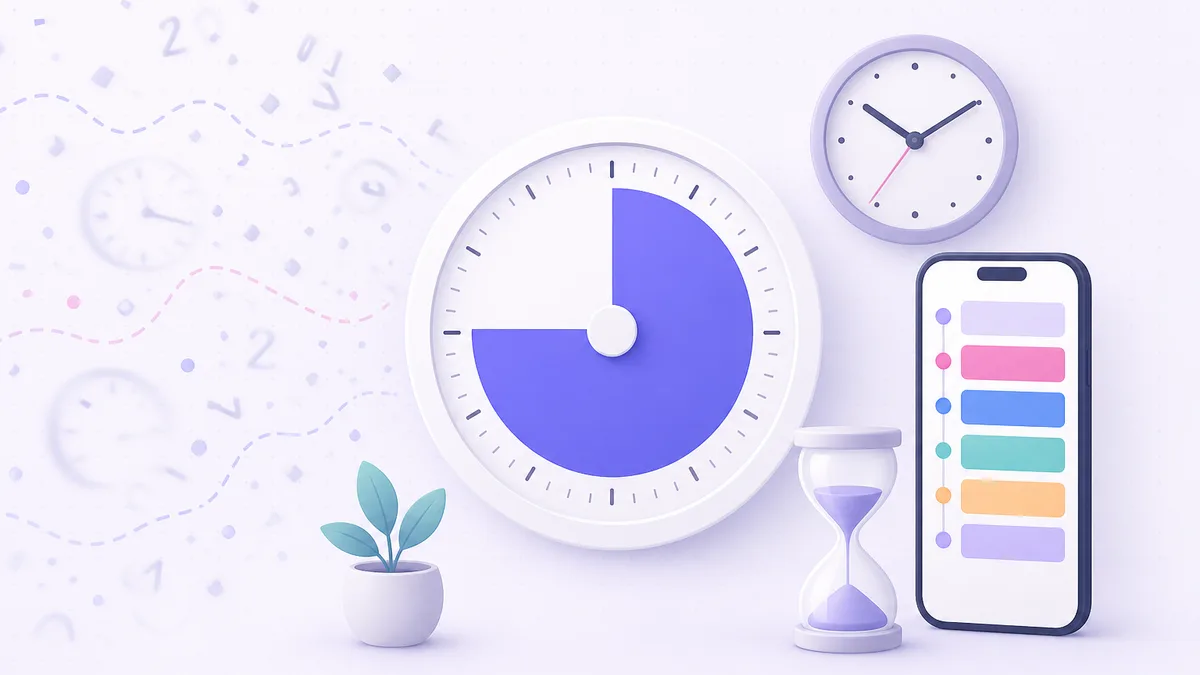
What Time Blindness Actually Is
Dr. Russell Barkley, one of the most cited ADHD researchers, describes ADHD as involving a fundamental impairment in the internal sense of time. Neurotypical brains run a background clock: they can feel that twenty minutes have passed, sense a deadline getting closer, and estimate how long a task will take. In many ADHD brains, that clock is unreliable — future events feel equally distant whether they're tomorrow or next month, and elapsed time simply doesn't register.
In daily life it looks like this:
- Chronic lateness — not from disrespect, but because "getting ready" genuinely feels like a 10-minute job when it takes 35.
- Deadline surprise — a due date is abstractly "coming up" until it's suddenly tomorrow and it's a crisis.
- "Just five more minutes" — hyperfocus with no internal alarm, so five minutes becomes ninety.
- Waiting-mode paralysis — an appointment at 3pm ruins the whole day, because your brain can't safely "use" the time before it.
- Underestimating everything — the planning fallacy affects everyone, but research on ADHD time perception shows it hits significantly harder.
Two things follow from the neurology. First, it's not a character flaw, and shame-based fixes ("just be more careful") don't work. Second, willpower-based fixes don't work either — you can't strengthen a sense you don't reliably have. What works is moving time out of your head entirely.
The One Principle Behind Everything: Externalize Time
Every effective time blindness strategy does the same job: it takes something your brain won't do internally (feel time passing, feel a deadline approaching, estimate a duration) and makes it external, visible, and physical. Clinicians consistently recommend the same hierarchy: time you can see beats time you can look up, and time that interrupts you beats time you have to remember to check.
But there are two levels to this, and most advice only covers the first:
- Level 1 — feel the minutes: clocks, timers and alarms that make time passing perceptible during a task. Cheap, physical, worth doing today.
- Level 2 — hold the schedule: a system that knows where every task, meeting and deadline lives in time, so nothing depends on your internal clock at all. This is where timers stop helping and your calendar takes over.
Level 1: Three Quick Physical Fixes (~$30, Ten Minutes of Setup)
Analog clocks — for "time isn't real in this room"
The cheapest fix on this list. An analog clock shows time as a physical arc — you can see a quarter of an hour as a shape, which digital numbers never convey. Clinical guidance for ADHD consistently favors analog over digital for exactly this reason. Put one large wall clock in every room where time matters: office, kitchen, bathroom. Yes, the bathroom — that's where mornings dissolve.
A visual countdown timer — for single work blocks
A shrinking-disk timer (the kind occupational therapists use in classrooms, ~$25–40 for a physical one) turns duration into a shape that visibly shrinks. Start it at the beginning of every focus block. When the disk is gone, the block is over — no mental math, no "wait, how long have I been here?". Any basic visual timer works; the mechanism matters, not the brand.
Alarm cascades — for appointments and leaving on time
Free, built into your phone, and one of the highest-impact habits: never set one alarm for an event. Set a cascade — 60 minutes before ("it's coming"), 30 minutes ("wrap up"), 10 minutes ("get ready"), and "leave now". Each alarm carries a specific instruction, so the time awareness lives in the alarms instead of in you. Label them accordingly: an alarm that just rings gets dismissed; an alarm that says "put shoes on" gets obeyed.
Level 2: The Real Fix Is a Calendar That Holds Time For You
Here's the pattern we see constantly with ADHD users: they own three timers and a smart watch, and their week still collapses — because the failure isn't inside a single task, it's between tasks. Which one is next? Does everything still fit after that meeting ran over? When exactly will you do the thing due Friday?
Those questions all require the one thing a time-blind brain can't produce: a reliable map of time. So the deepest fix is structural — a calendar where every commitment already has a place in time, without you doing the placing. Not a to-do list (lists have no time in them), not a manual time-blocking ritual you have to rebuild every time it breaks, but a system that does the placement and the re-placement for you.
This is exactly the job Flowo was built for — and why we built it around ADHD brains first. Here's how each piece maps to a specific time blindness failure:
The 5-Part System (One Tool, Five Time Blindness Fixes)
15-second capture — for tasks that vanish from working memory
The moment a task enters your head, it's already leaving. Flowo's capture takes about 15 seconds: title, deadline, rough duration, done. You don't decide when to do it — that's the AI's job. Capturing fast means no working memory overflow, and no "I know I was supposed to do something today" dread.
AI placement — for "I have no idea where this fits"
Flowo takes every captured task and places it into a real calendar slot, around your actual meetings, ordered by deadline and priority. The question time blindness can't answer — "when will I do this?" — stops existing. You open your day and it's already sequenced: do the first block, then the next.
All calendars merged — for the appointment you forgot existed
Double-bookings and forgotten commitments usually come from time being scattered across accounts: work Google, personal Gmail, a client's Outlook. Flowo merges every Google and Microsoft calendar into one view, and the AI plans around all of it. Your map of time is finally complete — which is the whole battle when your internal map doesn't exist.
One-click replanning — for the day that slipped by two hours
This is the moment every manual system dies: it's 3pm, the morning ran long, and re-fitting the rest of the week is a 20-minute executive-function puzzle soaked in guilt. In Flowo it's one click — the AI rebuilds the remaining days from reality, keeps deadlines safe, and nothing silently falls off the plan. Missed time stops compounding into missed weeks.
Flowy, the AI assistant — for tasks too vague to estimate
You can't put "prepare the launch" on a timeline if you have no idea whether it's 2 hours or 2 weeks. Ask Flowy to break it down: it turns a vague project into concrete, schedulable steps with durations, then plans them. Combine with the +50% rule — whatever a task feels like, budget half again — and your chronically optimistic estimates stop wrecking the week.
Two free techniques complete the picture. Body doubling — working alongside another person, in the room or on a call — anchors you in shared, witnessed time; early peer-reviewed research (2024–2025) supports what the ADHD community has long reported about initiation and sustained attention. And reverse time tracking: for one week, compare what you predicted tasks would take against reality. Most people find a consistent personal multiplier ("my estimates are half of reality") — and Flowo's planned-vs-done view gives you that comparison without extra bookkeeping.
Your Minimal Anti-Time-Blindness Stack
Tool-collecting is its own ADHD trap. You need one tool per failure point, not nine subscriptions you'll abandon by October. The complete stack:
- Feel time during tasks: one analog wall clock + one visual timer. ~$30 once.
- Never miss a departure: labeled alarm cascades on the phone you already own. Free.
- Hold the schedule: Flowo — capture in 15 seconds, AI placement across all your merged calendars, one-click replanning, and Flowy to break down what you can't estimate. One tool replacing the planner + the task app + the "figure out my week again" ritual.
If you want the full weekly method that sits on top of this stack, it's here: how to plan a week with ADHD. And if you're wondering why to-do lists specifically keep failing you, the dopamine article explains the other half of the picture. Curious how Flowo compares to other AI schedulers? We wrote the honest head-to-head.
Frequently Asked Questions
What is time blindness in ADHD?
Time blindness is an impaired internal sense of time, described by ADHD researcher Dr. Russell Barkley as a core feature of ADHD. It means difficulty feeling how much time has passed, estimating how long tasks take, and experiencing future deadlines as real — which leads to chronic lateness, deadline surprises, and lost hours during hyperfocus.
Is time blindness an official diagnosis?
No. "Time blindness" is not a standalone diagnosis in the DSM-5, but impaired time perception is well documented in ADHD research as part of executive function differences. Clinicians widely use the term because it accurately describes the lived experience.
What are the best tools for ADHD time blindness?
Work on two levels. To feel time during tasks: analog clocks in every relevant room, a visual shrinking-disk timer, and labeled alarm cascades for appointments. To hold your schedule: an AI calendar like Flowo, where every task gets a real time slot automatically, all your Google and Microsoft calendars are merged, and the plan rebuilds itself in one click when the day slips.
Can time blindness be cured or trained away?
There's no evidence you can train an internal clock into existence. The effective approach is compensation: externalizing time with visible clocks, timers, alarms that interrupt you, and a calendar system that holds the schedule so your brain doesn't have to. ADHD medication improves executive function for many people, which can indirectly help — that's a conversation for a clinician.
Why do people with ADHD underestimate how long things take?
Everyone underestimates task duration (the planning fallacy), but ADHD amplifies it: impaired time perception makes past durations hard to recall accurately and future durations hard to simulate. The practical fixes are the +50% rule (add half to every estimate), breaking vague tasks into concrete steps before estimating them, and comparing planned versus actual durations for a week to learn your personal multiplier.
How does Flowo help with time blindness?
Flowo removes the step time blindness breaks most: placing tasks into time. You capture a task in about 15 seconds with a deadline and duration; the AI schedules it into a real slot across all your merged Google and Microsoft calendars, and rebuilds the remaining week in one click when something overruns. The plan stays realistic without you having to sense time at all — and Flowy, the built-in assistant, breaks down projects you can't estimate.
Make time blindness someone else's job
Flowo anchors every task, meeting and note into one realistic schedule across all your Google and Outlook calendars — and rebuilds the plan in one click when time slips away. Built with ADHD brains in mind.
Start free (7 days) → No card for trial · Cancel anytime · 15-second task capture